
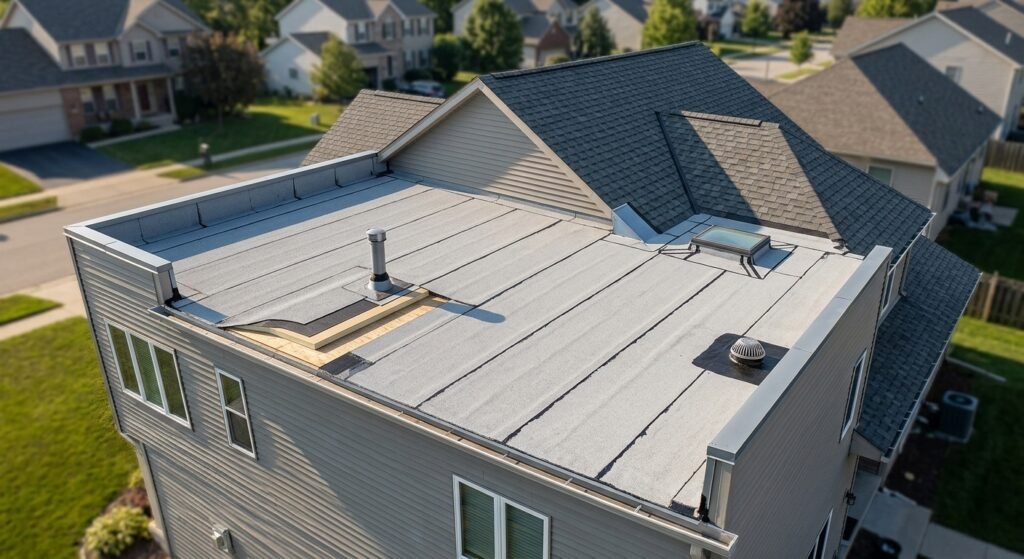
The West Texas Flat Roof Challenge
A flat roof in Lubbock faces weather extremes that would stress almost any standard roofing material to its breaking point — and modified bitumen was engineered specifically to handle conditions like these.
Lubbock’s climate is genuinely punishing. Summer surface temperatures on a flat roof can exceed 170°F under intense West Texas sun, yet the same city can absorb a 50-degree temperature drop within a single afternoon when a blue norther rolls through the Panhandle. Add sustained winds that regularly top 40 mph, along with occasional hail and blowing grit, and you have a roofing environment that demands something tougher than conventional materials.
Standard flat roofing failures follow a predictable pattern in this region. Traditional built-up roofing and basic single-ply membranes expand and contract with each thermal cycle, gradually fatiguing at seams, flashings, and penetrations. What typically happens is that hairline cracks form first, then moisture infiltrates, and the damage compounds quickly beneath the surface before a property owner even notices a problem.
Modified bitumen — often called mod bit — is essentially an evolved asphalt solution reinforced with polymer modifiers that give it flexibility and resilience far beyond what standard asphalt offers. Modified bitumen holds a 20.5% share of the Western U.S. low-slope roofing market, a clear signal that contractors and property owners in harsh climates consistently choose it over alternatives.
Application scope spans both residential and light commercial buildings. Whether you own a 1,200-square-foot bungalow with a low-slope addition or manage a small warehouse on the south side of Lubbock, a modified bitumen roof addresses the same core vulnerabilities. Understanding which specific membrane chemistry performs best here, however, is where the real decision begins.
SBS vs. APP: Choosing the Right Membrane for Lubbock
An SBS modified bitumen roof is the smarter choice for Lubbock because its rubber-like molecular structure absorbs the punishment of rapid temperature swings that APP-based membranes simply cannot match.
SBS defined. Styrene-Butadiene-Styrene is a synthetic rubber compound blended into asphalt during manufacturing. The result is a membrane that behaves more like rubber than traditional asphalt — flexing under stress instead of cracking. APP (Atactic Polypropylene), by contrast, blends a plastic polymer into the asphalt, producing a stiffer membrane that performs well in consistently hot climates but struggles when temperatures plunge quickly.
Why this matters in Lubbock. The Texas Panhandle is notorious for dramatic temperature swings — a warm afternoon can drop 40°F or more by midnight during a cold front. That thermal shock places enormous stress on roofing membranes. APP membranes become brittle at lower temperatures, making them vulnerable to cracking along seams and field areas. SBS membranes, because of their rubberized base, remain pliable well below freezing, which is exactly the behavior a Lubbock flat roof needs to survive winter.
Elongation and recovery. The technical measure that separates these two materials is elongation — a membrane’s ability to stretch under stress and return to its original shape. SBS membranes consistently achieve higher elongation ratings, which is why they dominate the U.S. market, accounting for 65% to 70% of all modified bitumen installed. That market share reflects a practical reality contractors and building owners have confirmed over decades. And that durability advantage becomes especially relevant when you consider how a multi-layer system multiplies the protection each membrane provides.
The Multi-Layer Advantage: Why Redundancy Matters
Modified bitumen’s greatest strength over single-ply membranes is not any single material property — it is the built-in redundancy of a multi-layer system that gives Lubbock roofs a fighting chance against hail, wind, and relentless UV exposure.
A single-ply membrane like TPO or EPDM is exactly what it sounds like: one layer of protection between your building and the elements. Modified bitumen, by contrast, is engineered as a system. A standard 2-ply assembly pairs a reinforced base sheet with a granule-surfaced cap sheet. A 3-ply system adds an intermediate ply, creating overlapping lines of defense that a single membrane simply cannot replicate.
Hail resistance is where this redundancy pays its most visible dividend in Lubbock. When a hailstone punctures or bruises the cap sheet, the base sheet beneath continues to perform as a waterproof barrier. In practice, what would be a catastrophic breach on a single-ply roof becomes a manageable surface repair — a distinction that directly affects your flat roof replacement cost over the life of the building.
Wind uplift is the other critical variable. Lubbock’s open-plain storms generate sudden, violent pressure differentials across rooftop surfaces. FM Global applies a 2:1 safety factor for wind uplift pressure ratings to ensure system integrity — a standard that underscores why the bond between every ply matters as much as the materials themselves. A properly adhered multi-layer system distributes uplift forces across the entire assembly rather than concentrating stress at seams.
The redundancy benefits of a multi-ply modified bitumen system include:
- Layered waterproofing that keeps the base sheet functional even when the cap sheet sustains impact damage
- Distributed wind load resistance across multiple bonded plies, reducing seam vulnerability
- Thermal buffering between layers that slows the daily expansion-contraction cycle Lubbock summers impose
- Self-adhered cap sheet options that eliminate open-flame torching on occupied buildings while maintaining a strong, clean bond
Self-adhered systems deserve particular attention. They use a factory-applied adhesive backing activated by peeling a release liner, removing the fire risk and permitting concerns associated with torch-down application. For retrofit projects on occupied commercial buildings — a common scenario in Lubbock’s older flat-roof stock — self-adhered modified bitumen offers a safer, faster installation path without sacrificing performance.
Choosing the right system is only half the equation. How that system gets installed, and at what cost, determines whether the redundancy you are paying for actually performs when a West Texas storm arrives — and that is exactly what the next section addresses.
Installation Realities and Cost Expectations
Modified bitumen roof installation is a precision process where method, materials, and craftsmanship combine to determine how long your Lubbock flat roof will actually last.
Having established why the multi-layer system delivers superior redundancy, it is worth understanding what goes into putting that system together — and what it costs to do it right.
Installation methods break down into three primary approaches, each suited to different building conditions. Torch-down application uses an open flame to heat and bond each membrane layer directly to the substrate, creating an exceptionally strong, seamless seal. Cold-applied systems use adhesives instead of heat, which tends to work better in situations where open flame poses a risk. Self-adhered membranes feature a factory-applied adhesive backing, making them a practical option for smaller sections or repairs. In practice, Lubbock contractors often combine methods across a single roof — torch-down for field areas, self-adhered for transitions.
Cost factors vary considerably based on roof size, slope, number of penetrations, existing damage, and the membrane grade specified. Homeowners should account for:
- Deck inspection and repair before new membrane installation
- Number of membrane layers (two-ply versus three-ply systems)
- Insulation upgrades required under current energy codes
- Flashing complexity around HVAC units, skylights, and parapet walls
- Disposal of existing roofing material
Professional installation is non-negotiable for one specific reason beyond quality: manufacturer warranties require it. A misapplied seam or an improperly primed substrate voids coverage entirely, leaving you without recourse when problems surface.
Material specification is equally critical. There are 26 distinct ASTM standard types and grades for modified bitumen products, a range wide enough that “builder grade” materials and commercial-quality membranes can look identical to an untrained eye. Always ask your contractor to reference the specific ASTM designation for the materials being installed. That single question separates informed buyers from those who discover the difference only after a hailstorm. And knowing what can go wrong after installation — ponding water, de-lamination, flashing failures — is the next layer of protection every Lubbock homeowner needs.
Common Problems and How to Prevent Them
The most preventable flat roof failures in Lubbock share a common thread: they begin as minor issues that go unaddressed until the damage reaches the building interior.
Understanding where modified bitumen systems are vulnerable — and how professional installation and routine care eliminate those vulnerabilities — is what separates a roof that lasts a decade from one that delivers the full 20-plus years owners expect.
Ponding water is the silent threat most Lubbock property owners underestimate. When water pools and sits for more than 48 hours, it accelerates membrane degradation, adds structural load, and finds even the smallest breach in a seam. The fix is not reactive — it is built into the installation through proper slope planning and drainage positioning before a single layer goes down.
De-lamination and blistering occur when moisture becomes trapped between layers or when adhesion is compromised during installation. Adequate substrate ventilation and correct torch or cold-adhesive application temperatures are what prevent these failures. As Peak PRC notes, poor installation is the leading cause of premature failure in modified bitumen systems, particularly at the seams — the exact locations where blistering typically begins.
Flashing failures at roof edges, drains, and penetrations like HVAC curbs are disproportionately responsible for interior water damage. These transition points demand careful detailing with compatible flashing materials and, critically, a professional eye during every inspection.
How long does a modified bitumen roof last under a disciplined maintenance schedule? A properly installed system with biannual inspections — typically in spring and fall — can reliably reach 20 years or more. Those inspections should prioritize seam integrity, flashing condition, and drainage clearance. The material is durable; what determines longevity is whether small problems get caught before they become costly ones.
The Bottom Line: What You Need to Know
Modified bitumen is the most resilient flat roofing system available for Lubbock properties, combining impact resistance, thermal flexibility, and layered redundancy into a single proven solution.
Hail and wind resistance set modified bitumen apart from competing membranes in a meaningful way. TPO systems, while widely marketed, tend to be more vulnerable to puncture and seam failure under the kind of hail strikes that regularly drive Lubbock roof storm damage claims. Modified bitumen’s reinforced polymer structure absorbs and distributes impact energy more effectively, which is why it remains a preferred specification for storm-prone regions across the southern plains.
SBS modifier chemistry is particularly well-suited to Lubbock’s temperature swings. Because SBS-modified bitumen stays flexible at low temperatures and resists softening during summer heat extremes, the membrane maintains a stable seal across the full annual cycle. In practice, this thermal elasticity reduces the micro-cracking and delamination that shorten the lifespan of less adaptive systems. According to SikaShield’s modified bitumen overview, this polymer modification directly improves long-term weathering performance.
A 2-ply installation adds the redundancy that single-layer systems simply cannot offer. When the cap sheet sustains surface damage, the base sheet continues to protect the roof deck and the building interior from water infiltration. That second layer is not a luxury — it is the difference between a minor repair and a full-scale interior remediation project.
ASTM-rated materials and professional installation complete the equation. Selecting membranes that meet ASTM standards for modified bitumen sheet products ensures the system performs as specified. But materials alone cannot guarantee longevity — correct torch application, proper overlap, and thorough seam sealing require trained hands. Choosing a contractor who understands both the product specifications and Lubbock’s climate conditions is ultimately what determines how long your roof performs without intervention.
Securing Your Lubbock Property with Elite Crown Roofing
When your flat roof faces Lubbock’s relentless hail, wind, and thermal swings, you need an installation team that understands storm-rated systems from the ground up.
Storm-rated installations are the foundation of what Elite Crown Roofing delivers. Every project prioritizes proper membrane adhesion, reinforced flashing details, and code-compliant layering that holds up when a West Texas storm rolls in without warning. That commitment to performance-first installation is what separates a roof that lasts from one that fails at the worst possible moment.
Insurance claim navigation is another area where homeowners and commercial property owners consistently need support. Storm damage documentation, adjuster coordination, and accurate scope-of-loss reporting can feel overwhelming after a major weather event. Elite Crown Roofing works directly with Lubbock storm victims to streamline that process, helping you understand what your policy covers and making sure nothing gets missed in the claim.
Worksite cleanliness matters more than most property owners expect. A flat roof replacement on a residential property involves materials, adhesives, and old membrane debris that can disrupt your household if managed carelessly. A clean, organized, and efficient jobsite protects your landscaping, your exterior finishes, and your peace of mind throughout the project.
And ultimately, none of this begins without a professional assessment. If your flat roof has not been inspected since the last major storm season, now is the time to act. Schedule a professional roof inspection with Elite Crown Roofing and get a clear picture of where your property stands before minor issues become costly failures.