
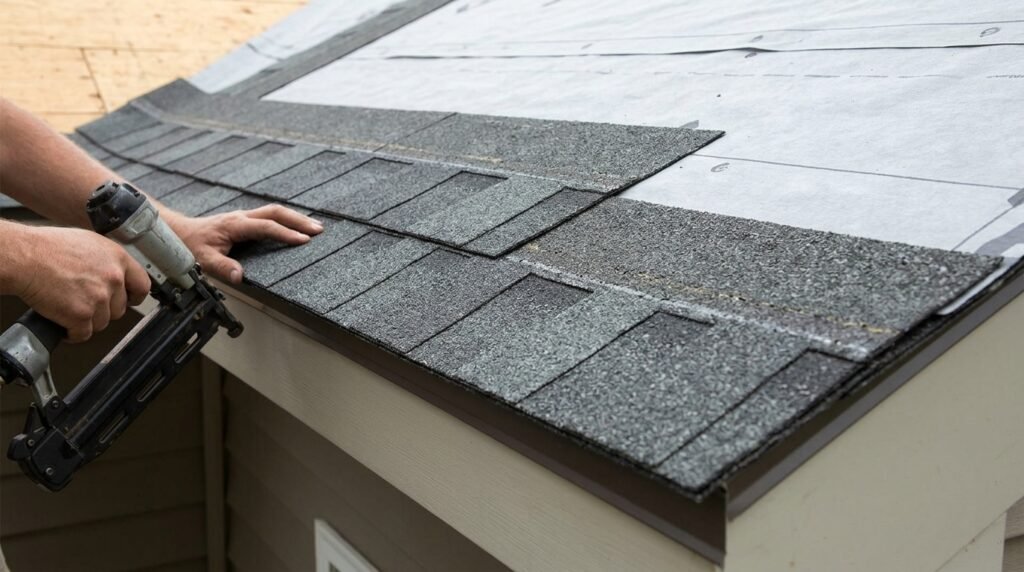
If you’re wondering what are starter shingles, they are specially designed shingles or starter strips installed along the starting edges of an asphalt shingle roof. They form the base for the first course of field shingles and help create a properly sealed roof edge. Starter shingles are particularly important along the eaves and rake edges, where wind can get underneath the roofing material.
Although starter shingles are a relatively small part of a roofing system, their installation can affect the roof’s edge protection, appearance, and wind performance. Choosing a compatible starter product and following the shingle manufacturer’s instructions are important for a properly installed roof.
What Are Starter Shingles?
Starter shingles, also called starter strips, are roofing components installed underneath or at the beginning of the first course of asphalt shingles. Unlike regular field shingles, they are specifically designed for the roof’s edges and typically include a sealant strip that helps bond the first course of shingles.
Manufacturers offer purpose-made starter strips in different designs. Some are supplied as individual starter shingles, while others come in rolls or perforated pieces designed for faster installation. Owens Corning, for example, offers starter products specifically designed to create a consistent starting row without cutting regular shingles.
Starter shingles are not simply decorative pieces. They are part of the roofing system and help establish the correct starting point for the shingles installed above them.
What Do Starter Shingles Do?
Starter shingles serve several important functions on an asphalt shingle roof.
They Create the First Roofing Course
The starter course establishes the foundation for the first visible row of field shingles. Proper positioning helps maintain consistent shingle alignment as the installer works upward across the roof.
They Help Seal the Roof Edge
Many starter products have an adhesive or sealant strip. When the first course of shingles is installed correctly, the sealing system helps bond the shingles together.
This is important because the roof edges are particularly exposed to wind.
They Help Reduce Shingle Blow-Off
Wind can get underneath poorly secured shingles and create lifting forces. Properly installed starter strips help secure the beginning edge of the roofing system and reduce the risk of wind-related shingle blow-off. GAF identifies starter strips as an important component for reducing blow-off risk along eaves and rakes.
They Help the Roof Shed Water
Starter shingles establish the edge of the shingle system so water can flow over the roofing surface rather than behind improperly positioned shingles.
However, starter shingles aren’t a substitute for flashing, underlayment, or proper roof drainage. They work as one component of a complete roofing system.
Where Are Starter Shingles Installed?
Starter shingles are commonly installed along the eaves and, depending on the roofing system and manufacturer’s requirements, along the rake edges.
Starter Shingles at the Eaves
The eave is the lower horizontal edge of a sloped roof. This is where water runs toward the roof edge and where the first course of shingles begins.
The starter course is positioned to create the appropriate overhang and sealing arrangement for the roofing system.
Starter Shingles at the Rake Edges
The rake is the sloped edge of a gable roof. Some shingle systems require starter strips along the rake as well as the eave, particularly where wind resistance and manufacturer warranty requirements are involved.
The exact installation details vary by product, so roofers should follow the instructions supplied with the shingles and starter product.
How Do Starter Shingles Work With a Drip Edge?
The drip edge and starter shingles perform different but complementary jobs.
A drip edge is a metal flashing component installed along roof edges to help direct water away from the roof deck and fascia. Starter shingles establish the beginning edge of the asphalt shingle system.
Their positioning needs to work together correctly. For example, Owens Corning’s installation instructions specify particular relationships between starter products, drip edges, and the roof edge. The required dimensions and sequencing can vary by product.
This is one reason a roofer shouldn’t rely on a generic starter-shingle installation method for every asphalt shingle product.
Are Starter Shingles Necessary?
For most asphalt shingle systems, a properly installed starter course is an important part of the roofing assembly. However, the exact starter product and installation method depend on the shingle manufacturer and roofing system.
Some manufacturers offer dedicated starter products, while certain shingles can be modified for use as a field starter when the manufacturer specifically approves that method. Owens Corning, for example, publishes product-specific instructions describing approved starter methods for certain shingle lines.
The important point is that installers should not assume that every asphalt shingle can be installed using the same starter method.
What Happens If Starter Shingles Are Skipped?
Skipping or incorrectly installing the starter course can contribute to:
- Poor edge sealing
- Increased vulnerability to wind
- Incorrect shingle alignment
- Improper roof-edge detailing
- Installation that doesn’t follow manufacturer requirements
That doesn’t mean every missing starter strip will automatically cause a roof leak. Roofing performance depends on the entire system, including shingles, underlayment, flashing, fastening, ventilation, and workmanship.
Types of Starter Shingles
There are several approaches to creating a starter course.
Manufactured Starter Strip Shingles
These are purpose-made starter products designed specifically for installation along roof edges. They can save installation time and provide a consistent starting edge.
Starter Shingle Rolls
Starter rolls provide a continuous strip that can be installed along the roof edge. Some products have integrated sealant and are designed to eliminate the need to cut individual shingle tabs.
Self-Sealing Starter Strips
Many starter products include a continuous sealant strip designed to bond with the overlying shingle course. The location and activation of the sealant depend on the product.
Field-Cut Starter Shingles
Some roofing systems permit regular shingles to be modified to create a starter course. This should only be done when the manufacturer’s installation instructions allow it.
How Are Starter Shingles Installed?
Starter shingle installation is more precise than simply placing a row of shingles along the roof edge.
1. Prepare the Roof Deck
The deck should be properly prepared and suitable for the roofing system. Damaged decking should be addressed before the shingles are installed.
2. Install the Required Underlayment and Edge Components
Underlayment and drip-edge requirements vary according to roof design, local requirements, and manufacturer instructions.
3. Position the Starter Course
The starter product is positioned along the appropriate roof edge with the required overhang and alignment.
4. Fasten the Starter Strips Correctly
Fastener location and spacing are product-specific. For example, Owens Corning installation instructions provide specific nail locations and quantities for its starter products.
Incorrect nail placement can interfere with the sealing system or reduce the effectiveness of the installation.
5. Install the First Course of Field Shingles
The regular asphalt shingles are installed over the starter course according to the manufacturer’s instructions.
6. Allow the Sealant to Bond
Many asphalt shingle systems rely on factory-applied sealant that activates under suitable conditions. The installer should follow the manufacturer’s requirements rather than assuming that every product seals in exactly the same way.
Starter Shingles vs. Regular Shingles
Starter shingles and regular field shingles may look similar, but they serve different purposes.
| Feature | Starter Shingles | Regular Field Shingles |
|---|---|---|
| Main location | Eaves and/or rakes | Main roof surface |
| Primary purpose | Establish starting edge and sealing | Cover the roof surface |
| Design | Made specifically for starter application | Designed for field courses |
| Sealant arrangement | Positioned for starter application | Designed for the field course |
| Installation | First roofing course | Installed above starter course |
Using the wrong material or orientation can create installation problems. Always check the manufacturer’s instructions for the specific shingle system.
Can You Use Regular Shingles as Starter Shingles?
Sometimes, but only when the manufacturer allows it.
Certain asphalt shingle systems provide an approved method for cutting or modifying field shingles to create a starter course. Other products require a specific manufactured starter strip.
For example, Owens Corning publishes an approved field-starter method for certain Duration shingle products, demonstrating why the correct answer depends on the specific roofing system.
Therefore, don’t assume that cutting a regular shingle in half is automatically an acceptable substitute for a starter product.
Do Architectural Shingles Need Starter Strips?
Architectural or laminated asphalt shingles generally use a compatible starter course as part of the roofing system. The exact starter product and installation method depend on the shingle manufacturer.
Some manufacturers provide dedicated starter strips designed to work with their architectural shingle products. These can provide a consistent edge and sealing surface while avoiding unnecessary cutting of field shingles.
If you’re replacing an architectural shingle roof, ask the roofing contractor which starter product is being used and whether it is approved for the selected shingles.
Common Starter Shingle Installation Problems
Even quality starter products can perform poorly when installation is incorrect.
Incorrect Overhang
Starter shingles need to be positioned according to the manufacturer’s specified roof-edge dimensions. Too much or too little overhang can affect the finished edge.
Improper Nail Placement
Nails placed in the wrong location can interfere with the sealing strip or fail to provide the intended fastening.
Poor Alignment
A crooked starter course can make subsequent shingle courses difficult to align correctly.
Incorrect Product
Using a starter product that isn’t compatible with the shingles can create problems with installation or warranty requirements.
Failure to Follow Manufacturer Instructions
This is one of the most preventable problems. Installation requirements can vary considerably between roofing products.
The Owens Corning roofing installation instructions provide product-specific examples of why roofers should check the instructions for the exact shingle and starter system being installed.
Why Starter Shingles Matter in High-Wind Areas
Roof edges are particularly important when considering wind resistance. Wind can place significant forces on shingles at the eaves and rakes, making proper fastening and sealing essential.
Starter strips help establish a secure base for the first course. However, starter shingles alone don’t determine a roof’s wind performance.
The complete system matters, including:
- Starter shingles
- Field shingles
- Correct nail placement
- Roof-edge detailing
- Drip edge
- Underlayment
- Manufacturer-approved installation methods
For homes exposed to strong winds, it’s especially important to select a roofing system with appropriate wind-performance specifications and have it installed according to the manufacturer’s requirements.
When Should Starter Shingles Be Replaced?
Starter shingles are generally replaced as part of a roof replacement, because they are located beneath the first course of field shingles.
If the starter course has been damaged by wind or the roof edge has experienced installation problems, a roofing professional can inspect the area and determine whether repair or broader replacement is necessary.
Trying to replace starter shingles without addressing the field shingles above them may not provide a practical long-term solution.
Frequently Asked Questions
What are starter shingles?
Starter shingles are specialized roofing strips installed along the starting edges of an asphalt shingle roof. They provide the base for the first course and help create a sealed, wind-resistant roof edge.
What do starter shingles do?
They establish the first shingle course, provide a sealing surface, and help protect the roof edges from wind-related shingle movement.
Are starter shingles necessary?
They are an important part of many asphalt shingle roofing systems. The specific product and installation method should follow the shingle manufacturer’s requirements.
Where do starter shingles go?
They are commonly installed along the eaves and may also be required along rake edges, depending on the roofing system.
Can you use regular shingles as starter shingles?
Some manufacturers permit field shingles to be modified for use as starters, but others require dedicated starter products. Always follow the instructions for the specific shingle.
Do architectural shingles need starter strips?
Most architectural asphalt shingle systems use a compatible starter course. The exact product and installation method vary by manufacturer.
What happens if starter shingles are installed incorrectly?
Improper installation can affect edge sealing, wind resistance, alignment, and compliance with the roofing manufacturer’s installation requirements.
Final Thoughts
Understanding what are starter shingles is important when evaluating an asphalt shingle roof. These specialized strips create the starting edge for the roofing system and help establish proper sealing and wind protection along vulnerable roof edges.
Starter shingles may seem like a minor component, but their placement, fastening, and compatibility with the field shingles matter. The correct installation method can vary between manufacturers and product lines, so roofing professionals should always follow the applicable installation instructions.
If you’re replacing an asphalt shingle roof or concerned about loose shingles, damaged roof edges, or improper starter-strip installation, a professional roof inspection can help determine whether the roofing system needs repair or replacement.