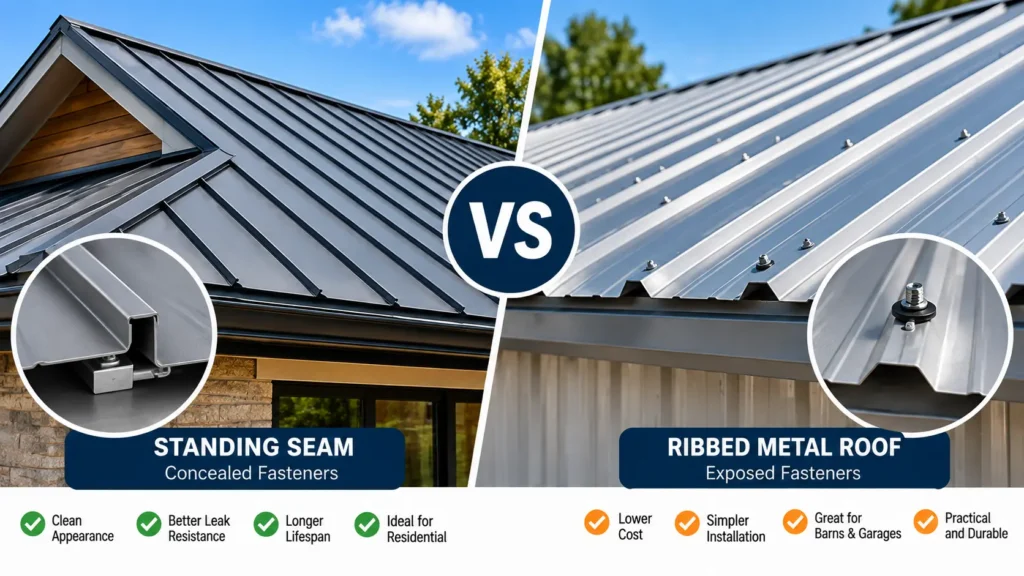
Standing seam and ribbed metal roofing are two common metal roofing systems, but they are built differently. Standing seam typically uses concealed clips or fasteners, while ribbed metal roofing generally uses exposed screws through the face of the panels. That difference affects cost, installation, maintenance, appearance, and long-term performance.
Difference Between Standing Seam and Ribbed Metal Roofing (The Best Answer)
For most residential projects, standing seam is the better choice when long-term performance, clean appearance, and reduced exposure of fasteners are priorities. Ribbed metal roofing is often the better value for barns, workshops, garages, agricultural buildings, and budget-focused projects because it is simpler and generally less expensive to install. The right choice ultimately depends on the building, roof design, climate, budget, and expected service life.
Standing Seam vs Ribbed Metal Roofing: Quick Comparison
| Feature | Standing Seam | Ribbed Metal Roofing |
|---|---|---|
| Fastening | Concealed | Exposed |
| Appearance | Clean, architectural | Ribbed, functional |
| Initial cost | Higher | Lower |
| Installation | More specialized | Simpler |
| Visible screws | No | Yes |
| Fastener exposure | Low | High |
| Maintenance | Generally lower | More attention to fasteners |
| Thermal movement | Designed into system | Depends on system |
| Residential use | Excellent | Possible |
| Agricultural use | Good | Excellent |
| Solar mounting | Often easier with seam clamps | Depends on mounting system |
The Metal Construction Association classifies standing seam and through-fastened panels as two basic categories of metal roof panel profiles. Standing seam systems use raised seams and concealed fastening, while through-fastened systems use fasteners that penetrate the panel. (Metal Construction Association)
What Is Standing Seam Metal Roofing?
A standing seam metal roof uses long metal panels connected by raised vertical seams. The panels are commonly secured with concealed clips or fastening systems beneath the seams.
Because the primary fasteners are hidden, the finished roof has uninterrupted panel surfaces without rows of exposed screw heads.
Standing seam systems can include different seam configurations, including snap-lock and mechanically seamed systems. The exact performance depends on the manufacturer’s panel design, clips, roof slope, substrate, and installation requirements.
One major advantage is that the fastening system can be designed to accommodate the natural expansion and contraction of metal panels. The Metal Construction Association explains that standing seam clips are specifically used to accommodate thermal movement while maintaining attachment performance. (Standing Seam Roof Clips Best Practices Guide)
Main advantages of standing seam
- Concealed primary fasteners
- Clean architectural appearance
- Reduced exposure of face fasteners
- Designed systems can accommodate thermal movement
- Excellent option for residential applications
- Suitable for many commercial buildings
- Compatible with certain clamp-mounted solar systems
What Is Ribbed Metal Roofing?
Ribbed metal roofing uses panels with raised ribs that provide strength and create the characteristic ribbed appearance.
Most ribbed systems are exposed-fastener roofing systems. Screws pass through the face of the panels and into the supporting structure. Sealing washers are installed beneath the screw heads to help protect the penetrations from water.
Ribbed panels are widely used for:
- Barns
- Workshops
- Garages
- Agricultural buildings
- Warehouses
- Industrial buildings
- Utility structures
- Some residential properties
Because the installation is relatively straightforward, ribbed metal roofing can provide a cost-effective alternative to premium concealed-fastener systems.
However, exposed fasteners require proper selection and installation. The Metal Construction Association explains that exposed fasteners must provide a strong, weather-tight attachment and should be compatible with the metal roofing system. (Fastener Compatibility with Profiled Metal Roof and Wall Panels)
The Main Difference: Concealed vs Exposed Fasteners
This is the most important distinction between the two roofing systems.
Standing seam
Standing seam normally uses concealed clips or fastening points beneath the raised seams.
Ribbed metal roofing
Ribbed roofing normally uses screws that penetrate the face of the panel and remain visible.
This means an exposed-fastener roof has many individual fastener locations that need to remain properly sealed.
Over time, fasteners and sealing washers can become maintenance points. Incorrect installation, over-tightening, under-tightening, deterioration, or movement can affect the seal.
The Metal Construction Association emphasizes that correct fastener selection is important for maintaining a strong and weather-tight attachment in profiled metal roofing systems. (MCA technical guidance on exposed fasteners)
Standing Seam vs Ribbed Metal Roof Cost
Ribbed metal roofing generally has the lower initial cost.
A ribbed system can be less expensive because the panels and fastening method are relatively straightforward.
Standing seam can cost more because it may require:
- Concealed clips
- Specialized trim
- More detailed flashing
- Precision fabrication
- More specialized installation
- Seaming equipment for mechanically seamed systems
- Experienced installers
However, the cheapest roof is not necessarily the least expensive over its entire service life.
When comparing the two systems, consider:
Material + installation + maintenance + repairs + expected service life
A lower initial price can be attractive, particularly for a barn or utility building. A homeowner planning to keep a property for decades may place more value on the concealed-fastener design and architectural appearance of standing seam.
Standing Seam vs Ribbed Metal Roof Installation
Ribbed metal roofing is generally simpler to install.
The panels are positioned over the roof structure and attached using exposed screws. Proper screw placement, spacing, washer compression, panel overlap, flashing, and sealants are important.
Standing seam requires more precise installation.
Depending on the system, the installer may need to:
- Position panels accurately.
- Install the correct clips.
- Allow for thermal movement.
- Interlock or mechanically seam the panels.
- Install specialized trim.
- Detail penetrations and transitions correctly.
The Metal Construction Association’s standing seam clip guidance explains that clip selection must account for thermal expansion and contraction as well as design loads.
For either system, installation quality is critical. A premium roofing panel cannot compensate for poor flashing, incorrect fastening, inadequate drainage, or improper installation.
For professional roof installation, inspection, repair, or replacement, Elite Crown Roofing provides roofing services for residential and commercial properties.
Standing Seam vs Ribbed Metal Roof Durability
Both roofing systems can provide long-term performance when properly specified and installed.
The difference is the exposure of the fastening system.
Ribbed roofing has exposed fasteners that are directly exposed to the environment. These include:
- Screws
- Sealing washers
- Fastener heads
- Panel laps
- Closures
- Sealants
Standing seam hides most primary fasteners beneath the seams or clips.
That reduces direct exposure of the fasteners, but it does not mean standing seam is maintenance-free.
The roof’s actual service life depends on:
- Metal type
- Panel thickness
- Coating
- Installation quality
- Climate
- Roof slope
- Drainage
- Flashing
- Fastener or clip selection
- Maintenance
Therefore, it is not accurate to claim that every standing seam roof will automatically outlast every ribbed metal roof.
Standing Seam vs Ribbed Metal Roof Maintenance
Ribbed metal roof maintenance
Exposed-fastener systems should be inspected for:
- Loose screws
- Missing screws
- Damaged sealing washers
- Rust around fasteners
- Failed sealant
- Loose panels
- Open panel laps
- Damaged flashing
- Deteriorated closures
Fasteners are one of the main maintenance considerations for exposed-fastener roofing.
Standing seam maintenance
Standing seam eliminates most exposed face fasteners, but the roof should still be inspected for:
- Damaged seams
- Loose components
- Flashing problems
- Roof penetrations
- Ridge details
- Valleys
- Edge conditions
- Drainage problems
- Storm damage
Elite Crown Roofing’s roof maintenance guide recommends regular inspections, flashing checks, drainage maintenance, and prompt attention to developing roof problems.
Which Roof Has Better Leak Resistance?
Neither system should be described as completely leak-proof.
The important difference is the number and type of penetrations.
With ribbed metal roofing, screws penetrate the panel face. Each penetration must be correctly installed and sealed.
Standing seam keeps the primary fasteners away from the exposed panel face.
This can reduce one category of potential water-entry points, but leaks can still occur around:
- Flashing
- Valleys
- Roof penetrations
- Seams
- Ridge details
- Roof-to-wall transitions
- Improperly installed accessories
- Damaged panels
The Metal Construction Association notes that exposed fasteners need to provide a weather-tight seal under applicable loading conditions.
Standing Seam vs Ribbed Metal Roof in Harsh Weather
The term “metal roof” alone does not tell you how well a particular system will perform in severe weather.
For wind, hail, heavy rain, or other demanding conditions, evaluate the actual roofing system’s:
- Panel gauge
- Fastener spacing
- Clip spacing
- Roof deck
- Structural support
- Edge attachment
- Roof slope
- Manufacturer testing
- Local building requirements
Standing seam can be particularly useful for complex architectural applications where the panels need to accommodate movement and maintain a clean appearance.
For example, the Metal Construction Association documented a Florida residence near the ocean where the architectural standing seam system was engineered for a demanding coastal and hurricane environment.
The lesson is not that standing seam automatically performs better in every storm. The important point is that the roofing system must be properly engineered and installed for its environment.
Standing Seam vs Ribbed Metal Roof for Residential Homes
For a primary residence, standing seam is generally the stronger premium option.
It provides:
- Cleaner appearance
- Concealed primary fasteners
- Less visible hardware
- Strong architectural appeal
- Good compatibility with modern designs
- A premium finished appearance
Ribbed metal roofing can still be appropriate for:
- Detached garages
- Workshops
- Agricultural homes
- Outbuildings
- Budget-focused residential projects
If appearance and long-term maintenance are major considerations, standing seam is usually worth serious consideration.
Standing Seam vs Ribbed Metal Roof for Barns and Agricultural Buildings
Ribbed metal roofing often makes more sense for agricultural and utility buildings because these projects frequently prioritize:
- Low initial cost
- Simple installation
- Easy material availability
- Functional performance
- Straightforward maintenance
A barn or workshop does not necessarily need the architectural appearance of a standing seam system.
For these applications, ribbed panels can provide a practical balance between cost and performance.
Standing Seam vs Ribbed Metal Roof and Solar Panels
Standing seam can have an important advantage when solar panels are planned.
Many solar mounting systems can clamp directly to the raised standing seams rather than requiring penetrations through the roof panels.
The Metal Construction Association explains that properly designed standing seam solar clamps can attach to the seams without penetrating the roof surface. For exposed-fastener roofs, the attachment penetrates the roof, making the integrity of the seal particularly important.
The exact mounting method should always be compatible with the roofing manufacturer’s requirements.
Standing Seam vs Ribbed Metal Roof and Energy Efficiency
The panel profile alone does not determine energy efficiency.
Important factors include:
- Roof color
- Coating
- Solar reflectance
- Thermal emittance
- Insulation
- Ventilation
- Climate
- Building design
The U.S. Department of Energy explains that solar reflectance and thermal emittance are important characteristics when evaluating cool roof performance. (U.S. Department of Energy — Cool Roof Products)
Therefore, don’t assume standing seam is automatically more energy efficient than ribbed metal roofing.
A reflective coating and appropriate insulation can be more important than the panel profile itself.
Standing Seam vs Ribbed Metal Roof Appearance
Standing seam
Standing seam generally provides:
- Long vertical lines
- Minimal visible hardware
- Clean roof planes
- Contemporary appearance
- Architectural character
Ribbed metal roofing
Ribbed roofing generally provides:
- Pronounced ribs
- Visible screw heads
- More industrial appearance
- Functional panel styling
For modern homes and architectural properties, standing seam is usually the more visually refined option.
For barns, workshops, and agricultural buildings, ribbed roofing is often a natural fit.
Pros and Cons of Standing Seam
Pros
- Concealed primary fasteners
- Clean appearance
- Strong architectural appeal
- Less exposure of face fasteners
- Good option for residential roofing
- Can simplify some solar mounting applications
- Designed systems can accommodate thermal movement
Cons
- Higher initial cost
- More specialized installation
- More expensive accessories
- Requires experienced installation
- Repairs may require specialized knowledge
Pros and Cons of Ribbed Metal Roofing
Pros
- Lower initial cost
- Simpler installation
- Widely available
- Good for barns and agricultural buildings
- Practical for garages and workshops
- Functional appearance
- Easy to understand and maintain
Cons
- Exposed fasteners
- Exposed sealing washers
- More visible hardware
- Fastener deterioration can become a maintenance issue
- More penetrations through the panel face
Which Is Better: Standing Seam or Ribbed Metal Roofing?
Choose standing seam when you want a premium residential or architectural roofing system with concealed fastening, clean aesthetics, and reduced exposure of face fasteners.
Choose ribbed metal roofing when affordability, straightforward installation, and functional performance are more important—particularly for barns, garages, workshops, agricultural buildings, and utility structures.
The decision should not be based on panel price alone. Compare the complete roofing system, including:
- Panel material
- Gauge
- Coating
- Fasteners or clips
- Roof slope
- Flashing
- Underlayment
- Installation
- Warranty
- Maintenance requirements
For an existing roof, a professional roof inspection can help determine whether the current structure is suitable for a new metal roofing system and identify problems with decking, flashing, drainage, or existing roof materials.
Frequently Asked Questions
Is standing seam better than ribbed metal roofing?
For many residential applications, standing seam is the better premium option because it uses concealed primary fasteners and offers a cleaner appearance. Ribbed roofing can provide better value for budget-focused and agricultural projects.
Is ribbed metal roofing cheaper than standing seam?
Generally, yes. Ribbed exposed-fastener systems are usually simpler to manufacture and install, which can reduce upfront costs.
Which lasts longer, standing seam or ribbed metal roofing?
There is no universal lifespan for either system. Material quality, coating, installation, climate, drainage, and maintenance all affect longevity.
Does ribbed metal roofing leak?
It can develop leaks if screws, washers, panel laps, flashing, or other components are improperly installed or deteriorate. Proper installation and maintenance are essential.
Does standing seam metal roofing leak?
Standing seam can also develop leaks around seams, flashing, penetrations, valleys, edges, or damaged components. Concealed fasteners reduce exposed face penetrations but do not eliminate every possible leak source.
Is standing seam worth the extra cost?
For homeowners who prioritize appearance, concealed fastening, and long-term performance, the additional investment can be worthwhile. For a barn, workshop, or utility building, ribbed roofing may provide better value.
Can solar panels be installed on standing seam roofing?
Yes. Compatible solar mounting systems can often clamp directly to standing seams without penetrating the roof panel. The mounting system must be compatible with the specific roofing profile.
Final Verdict
Standing seam and ribbed metal roofing are both useful systems, but they are designed for different priorities.
Standing seam is generally the better choice for residential and architectural projects where appearance, concealed fastening, and long-term performance are important.
Ribbed metal roofing is generally the better choice for barns, workshops, garages, agricultural buildings, and budget-conscious projects where lower upfront cost and simpler installation matter more.
The most important factor is not simply choosing one panel profile over another. The roof needs to be correctly designed for the building, climate, slope, drainage, structural requirements, and installation method.
A properly specified and installed metal roof can provide excellent performance. A poorly installed system can develop problems regardless of whether it is standing seam or ribbed.