
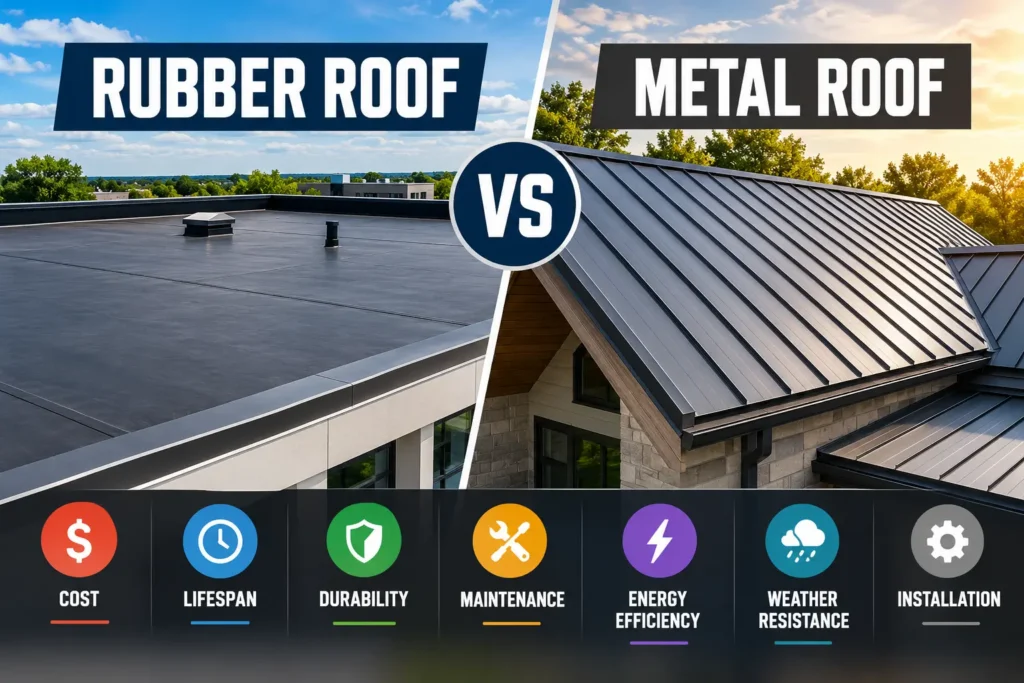
When choosing a new roofing system, property owners often compare rubber roof vs metal roof options. Both materials can provide dependable protection, but they have different strengths when it comes to cost, lifespan, durability, maintenance, energy efficiency, weather resistance, and installation.
Rubber roofing, particularly EPDM roofing, is commonly used for flat and low-slope applications because its flexible membrane creates a continuous waterproofing layer. Metal roofing, including standing seam metal roofing, is known for its strength, longevity, fire resistance, and relatively low maintenance requirements.
Which is better: rubber roofing or metal roofing? (Best Answer)
The answer depends on the building, roof slope, climate, drainage design, budget, and long-term goals. This guide compares the two systems to help you determine which roofing material may be the better fit for your property.
Rubber Roof vs Metal Roof: What’s the Difference?
The primary difference between these roofing systems is their construction.
A rubber roof generally uses a flexible membrane installed across the roof surface. EPDM, or ethylene propylene diene monomer, is one of the most widely recognized rubber roofing materials. It is particularly common on flat and low-slope roofs.
A metal roof uses panels made from materials such as steel or aluminum. Standing seam metal roofing is one popular design in which adjacent panels connect through raised seams.
Both systems can perform well when properly designed and installed, but they are suited to somewhat different applications.
What Is Rubber Roofing?
Rubber roofing is commonly associated with membrane roofing systems used on flat and low-slope buildings. EPDM rubber roofing is particularly popular because the material is flexible and can provide a durable waterproofing layer.
A rubber membrane roof can be suitable for:
- Flat roofs
- Low-slope roofs
- Commercial buildings
- Garages
- Residential additions
- Certain industrial buildings
- Other structures requiring membrane waterproofing
One of the major advantages of EPDM roofing is flexibility. Instead of relying on rigid panels, the membrane covers the roof surface as a continuous roofing layer.
However, installation details remain extremely important. Seams, flashing, roof penetrations, drainage systems, and edge details must be correctly installed to reduce the risk of water intrusion.
For low-slope properties, drainage deserves particular attention. See this detailed guide to modern flat roof drainage systems from Elite Crown Roofing for more information about drains, slope, ponding water, and overflow protection.
What Is Metal Roofing?
Metal roofing uses durable panels manufactured from materials such as steel, aluminum, or coated metal products.
One of the most common systems is standing seam metal roofing. These systems use raised seams between panels, helping create a durable roof assembly while reducing exposed fasteners on certain designs.
Metal roofing is often selected because of its:
- Long potential service life
- Durability
- Fire resistance
- Weather resistance
- Low maintenance requirements
- Recyclability
- Wide range of colors and finishes
- Compatibility with certain solar installations
The Metal Construction Association reports that certain metal roof systems can have a service life of at least 60 years when properly designed and installed.
That does not mean every metal roof will automatically last 60 years. Roof design, material quality, coating, climate, installation, maintenance, and environmental exposure all influence actual performance.
Rubber Roof vs Metal Roof Cost
Cost is one of the biggest factors when comparing roofing materials.
There is no universal price for a rubber roof or metal roof because the final project cost depends on many variables, including:
- Roof size
- Roof pitch
- Existing roof condition
- Roof deck condition
- Tear-off requirements
- Insulation
- Flashing
- Drainage
- Roofing material
- Labor
- Building accessibility
- Local building requirements
A rubber roofing system may be cost-effective for a flat or low-slope roof where a membrane system is appropriate.
Metal roofing can have a higher initial installation cost in some situations, but its long potential service life can make it attractive from a long-term perspective.
Instead of comparing only the installation price, property owners should consider total cost of ownership. A roofing system with a lower initial price may not necessarily be cheaper if it requires frequent repairs or earlier replacement.
Rubber Roof vs Metal Roof Lifespan
How long a roof lasts is another important consideration.
Metal roofing can have an exceptionally long service life. Research published by the Metal Construction Association indicates that certain low-slope standing seam metal roof systems can have expected service lives exceeding 60 years under appropriate conditions.
Rubber roofing can also provide many years of service, but its actual lifespan depends on factors such as:
- Membrane quality
- Installation quality
- UV exposure
- Weather conditions
- Drainage
- Maintenance
- Foot traffic
- Roof penetrations
- Repair history
Therefore, when comparing rubber roof lifespan vs metal roof lifespan, it is better to look at the entire roofing system rather than relying on a single advertised lifespan.
Installation quality is especially important. A premium roofing material can still experience premature problems when seams, flashing, drainage, or penetrations are poorly installed.
Rubber Roof vs Metal Roof Durability
Durability is one area where metal roofing has a significant advantage.
Metal panels can provide excellent resistance to many environmental conditions and can withstand demanding weather when properly engineered and installed.
The Metal Construction Association notes that metal roofing systems can provide significant durability and longevity, with some systems reaching service lives of 60 years or more.
Rubber roofing offers a different type of durability.
EPDM membranes are flexible and can accommodate movement within the roofing system. They can also provide strong resistance to weathering and ultraviolet exposure.
However, rubber membranes can be vulnerable to punctures caused by sharp objects, improper foot traffic, equipment, or maintenance activities.
This means the question is not simply which material is stronger. The better question is:
Which roofing system is better suited to the building and its environment?
Rubber Roof vs Metal Roof for Flat Roofs
For flat and low-slope applications, rubber roofing deserves serious consideration.
EPDM and other membrane systems are widely used for low-slope roofing because they can create a continuous waterproofing layer.
Metal roofing can also be used on certain low-slope buildings, but the specific panel system, seam design, slope requirements, flashing, and drainage design must be appropriate for the application.
Drainage is particularly important on a flat or low-slope roof.
A roof should be designed to move water toward drains, scuppers, or other appropriate outlets. Persistent ponding water can place additional stress on the roofing system and contribute to premature deterioration.
For a deeper explanation, read Why Modern Flat Roof Drainage Details Fail on Elite Crown Roofing.
Rubber Roof vs Metal Roof Maintenance
Neither roofing system should be considered completely maintenance-free.
Rubber roof maintenance generally involves inspecting:
- Membrane seams
- Flashing
- Roof penetrations
- Drainage systems
- Punctures
- Sealants
- Ponding water
- Surface deterioration
Metal roof maintenance may involve inspecting:
- Panel seams
- Fasteners
- Flashing
- Coatings
- Corrosion
- Roof penetrations
- Gutters
- Drainage components
Regular inspections can identify small problems before they become expensive repairs.
Elite Crown Roofing’s Ultimate Guide to Roof Maintenance explains how regular inspections, drainage checks, flashing inspections, and preventive maintenance can help protect a roofing investment.
For commercial properties, a documented maintenance program can be particularly useful. See this guide to commercial roof maintenance agreements for additional information.
Rubber Roof vs Metal Roof Energy Efficiency
Energy efficiency is more complicated than simply choosing rubber or metal.
A roof’s energy performance can be affected by:
- Solar reflectance
- Thermal emittance
- Roof color
- Insulation
- Building design
- Ventilation
- Climate
- HVAC efficiency
The U.S. Department of Energy explains that cool-roof performance depends on properties such as solar reflectance and thermal emittance. Climate and building characteristics also influence potential energy savings.
You can review the U.S. Department of Energy’s guidance on cool roofing products for more information.
Metal roofing can be designed with reflective coatings and lighter colors that reduce solar heat absorption.
Rubber roofing can also be available in reflective or light-colored options.
Therefore, it is not accurate to say that every metal roof is automatically more energy efficient than every rubber roof. The complete roofing assembly matters.
Rubber Roof vs Metal Roof in Extreme Weather
Weather resistance is another important factor when comparing these roofing systems.
Metal roofing is well known for its durability in demanding weather conditions. Properly designed systems can provide strong resistance to wind, fire, snow, hail, and other environmental stresses.
The Metal Construction Association describes metal roofing as highly durable and capable of withstanding extreme weather conditions.
Rubber roofing can also perform well in harsh weather because EPDM membranes are flexible and designed for outdoor exposure.
However, the performance of either system depends heavily on installation.
For example, a roofing system may have excellent material characteristics but still experience leaks because of:
- Poor flashing
- Improper seams
- Failed sealants
- Poorly installed penetrations
- Inadequate drainage
- Improper edge detailing
This is why the quality of the roofing installation matters almost as much as the material selection.
Rubber Roof Repair vs Metal Roof Repair
Both rubber and metal roofing systems can often be repaired when damage is localized.
Rubber roof repair may involve:
- Patching membrane damage
- Repairing seams
- Replacing damaged flashing
- Repairing roof penetrations
- Addressing drainage problems
Metal roof repair may involve:
- Replacing damaged panels
- Repairing seams
- Replacing fasteners
- Treating corrosion
- Repairing flashing
- Recoating certain surfaces
A localized problem does not necessarily mean the entire roof needs to be replaced.
If you are dealing with limited damage, Elite Crown Roofing’s guide on how to perform a partial roof repair explains situations where localized repairs may be appropriate.
Rubber Roofing Pros and Cons
Advantages of Rubber Roofing
- Excellent option for many flat and low-slope roofs
- Flexible membrane material
- Continuous waterproofing surface
- Lightweight compared with some roofing systems
- Available in reflective options
- Suitable for many commercial applications
- Can be repaired when damage is localized
Disadvantages of Rubber Roofing
- Membrane can be punctured
- Seams require careful installation
- Drainage problems can contribute to premature deterioration
- Regular inspection is important
- Lifespan varies according to material, installation, and maintenance
Metal Roofing Pros and Cons
Advantages of Metal Roofing
- Long potential service life
- Excellent durability
- Strong weather resistance
- Fire-resistant characteristics
- Relatively low maintenance
- Wide range of styles and finishes
- Highly recyclable
- Can be suitable for solar installations
Disadvantages of Metal Roofing
- Initial installation can be more expensive
- Incorrect installation can result in leaks
- Thermal expansion and contraction must be considered
- Scratches or coating damage may lead to corrosion
- Some metal systems are unsuitable for very low-slope applications
- Matching older panels during repairs can sometimes be difficult
Which Is Better: Rubber Roof or Metal Roof?
So, which is better: rubber roof or metal roof?
There is no universal winner.
A rubber roof may be the better option when you have a flat or low-slope roof and need a flexible membrane waterproofing system.
Metal roofing may be the better option when long-term durability, fire resistance, low maintenance, and extended service life are major priorities.
Consider these factors before making a decision:
- What is the roof slope?
- How large is the roof?
- What is the condition of the existing roof deck?
- How does water currently drain from the roof?
- What type of weather does the building experience?
- How long do you plan to own the property?
- What is your initial budget?
- What are the expected maintenance costs?
- What warranty is available?
- Does the contractor have experience installing the selected roofing system?
Rubber Roof vs Metal Roof: Final Verdict
When comparing rubber roof vs metal roof, both systems offer valuable advantages.
EPDM rubber roofing can be an excellent choice for many flat and low-slope applications because of its flexibility and waterproofing capabilities.
Metal roofing can be an excellent choice for property owners who prioritize durability, longevity, fire resistance, low maintenance, and long-term value.
The best choice ultimately depends on the building’s design, roof slope, drainage, climate, budget, and long-term plans.
Don’t choose a roofing material based solely on its advertised lifespan or initial installation price. The quality of the entire roofing assembly—and the quality of installation—can have a major effect on long-term performance.
A professional roof assessment can help determine whether rubber membrane roofing, standing seam metal roofing, or another roofing system is appropriate for your property.
Frequently Asked Questions
Is a rubber roof better than a metal roof?
Neither roofing material is universally better. Rubber roofing is often well suited to flat and low-slope roofs, while metal roofing can be preferable when durability, longevity, fire resistance, and low maintenance are priorities.
Does a rubber roof last longer than a metal roof?
Metal roofing systems can have very long service lives, with some systems reaching 60 years or more under appropriate conditions. Rubber roof longevity varies depending on membrane type, installation, weather exposure, drainage, and maintenance.
Is a rubber roof cheaper than a metal roof?
The answer depends on the project. Rubber roofing can be cost-effective for suitable flat and low-slope applications, while metal roofing may have a higher initial installation cost but potentially lower long-term replacement costs.
Which is better for a flat roof, rubber or metal?
Rubber membrane roofing is commonly used on flat and low-slope roofs. Metal roofing can also be used in appropriate applications, but the specific metal system must be compatible with the roof slope and drainage design.
Which roof requires less maintenance?
Both systems can be relatively low-maintenance when properly installed. Metal roofing generally requires limited maintenance, while rubber roofing requires regular inspection of membrane seams, flashing, penetrations, and drainage.
Is EPDM the same as a rubber roof?
EPDM is a type of synthetic rubber roofing membrane. The term “rubber roof” is often used when referring to EPDM, although other rubber-based roofing materials also exist.
Can rubber roofing and metal roofing be used on the same building?
Yes. Different roofing systems can sometimes be used on different sections of the same building. However, transitions between systems must be properly designed and waterproofed.
What is the most important factor when choosing between rubber and metal roofing?
The most important consideration is selecting a roofing system that matches the building’s roof slope, structure, drainage requirements, climate, and intended use. Professional installation is also essential for long-term performance.