
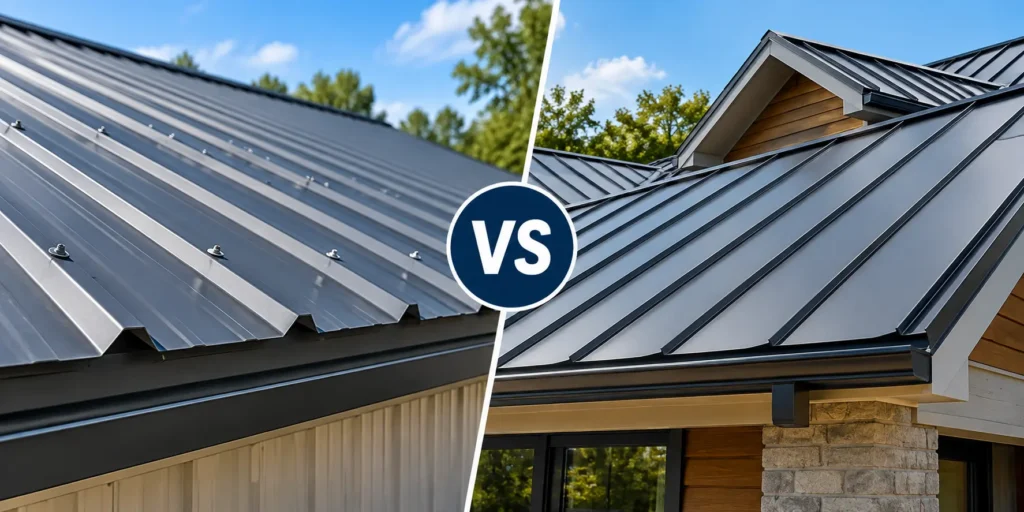
Choosing between an R panel metal roof vs standing seam comes down to more than appearance. Both are metal roofing systems, but they differ significantly in fastening, installation, cost, maintenance, and how the panels manage weather exposure and movement.
Difference between R Panel Metal Roof and Standing Seam (The Best Answer)
For most homeowners looking for a long-term residential roofing system, standing seam is generally the better choice because its concealed fastening system protects fasteners from direct weather exposure and allows properly designed panels to accommodate thermal movement. R-panel roofing is usually the more budget-friendly option and can make sense for agricultural, commercial, utility, and other buildings where lower initial cost and simpler installation are more important. The best choice depends on the building, budget, roof design, climate, and expected service life.
R Panel Metal Roof vs Standing Seam: What’s the Difference?
The biggest technical difference is the fastening system.
R-panel roofing is an exposed-fastener metal roofing system. Screws pass through the face of the panels and remain visible after installation. Standing seam roofing generally uses concealed fasteners and clips, with the panels connected at raised seams.
The Metal Construction Association describes standing seam systems as profiles where face-fastening is minimized or eliminated, while exposed-fastener systems use visible fasteners through the panels.
That distinction affects maintenance, appearance, installation, and long-term water-management considerations.
| Feature | R-Panel Metal Roof | Standing Seam Metal Roof |
|---|---|---|
| Fastening | Exposed | Concealed |
| Initial cost | Generally lower | Generally higher |
| Installation | Simpler | More specialized |
| Appearance | Ribbed, industrial | Clean, modern |
| Fasteners visible | Yes | Generally no |
| Maintenance | Fasteners require attention | Generally lower fastener exposure |
| Thermal movement | Depends on system/design | Designed around panel movement |
| Residential use | Possible | Very common |
| Commercial use | Common | Common |
| Agricultural use | Very common | Possible |
| Long-term premium option | No | Yes |
What Is an R-Panel Metal Roof?
An R-panel metal roof is a ribbed metal panel system commonly installed using exposed fasteners.
The panel has raised ribs that provide structural shape and create the characteristic appearance associated with R-panel roofing. The panels are attached with screws that penetrate the metal.
Because the fasteners are visible, the condition and installation of those fasteners are important parts of the roofing system.
R-panel systems are commonly used on:
- Agricultural buildings
- Workshops
- Garages
- Warehouses
- Commercial buildings
- Industrial structures
- Utility buildings
- Some residential properties
R-panel roofing can provide good performance when properly specified and installed. Its main attraction is usually the combination of lower material and installation costs with straightforward construction.
What Is a Standing Seam Metal Roof?
A standing seam metal roof uses long metal panels connected through raised vertical seams.
Instead of driving screws through the exposed face of every panel, many standing seam systems use concealed clips and fasteners. Some systems are mechanically seamed after installation, while others use snap-lock or nail-strip configurations.
The Metal Construction Association notes that standing seam systems require specific clip selection and fastening techniques to accommodate thermal expansion and contraction while maintaining appropriate attachment performance.
This makes standing seam more than simply a different-looking metal panel. The fastening and movement strategy is fundamentally different.
R Panel vs Standing Seam Cost
If upfront price is your biggest concern, R-panel generally has the advantage.
R-panel systems use relatively straightforward panels and exposed fasteners. Installation can require less specialized equipment and expertise than some standing seam systems.
Standing seam usually costs more because the system requires:
- More specialized panel fabrication
- Concealed clips or fastening components
- More detailed installation
- Greater attention to panel alignment
- Specialized seaming equipment for some systems
- More precise detailing around penetrations and transitions
However, the cheapest installation is not necessarily the cheapest roof over its entire service life.
When comparing R-panel vs standing seam cost, consider the complete system rather than the panel price alone:
Material + installation + maintenance + repairs + expected service life = real roofing cost.
A low initial price can be attractive, but long-term maintenance and replacement considerations should also influence the decision.
R Panel vs Standing Seam Installation
R-panel installation is generally simpler.
The panels are placed over the roof structure or substrate and secured with exposed screws. Proper screw placement, alignment, spacing, and sealing are critical.
Standing seam installation requires greater precision. Depending on the system, installers may need to work with concealed clips, panel locks, seams, and mechanisms designed to accommodate thermal movement.
This is one reason professional installation is particularly important with standing seam roofing.
The Metal Construction Association’s technical guidance emphasizes that standing seam clips must be selected appropriately for the system and design loads.
For either system, installation quality can have a major effect on long-term performance. Roof slope, underlayment, flashing, penetrations, drainage, and attachment details all need to work together.
Elite Crown Roofing’s roof installation services cover roof installation, inspections, repairs, and replacement, making a professional assessment useful when selecting a roofing system.
R Panel vs Standing Seam Durability
Both systems can be durable when correctly designed and installed.
The difference is how the systems deal with their connections and exposed components.
R-panel has exposed screws. Those fasteners are directly exposed to weather, and their condition can become an important maintenance consideration.
Western States Metal Roofing explains that exposed-fastener systems rely on screws and sealing washers, while standing seam systems use concealed clips and fasteners. It also notes that improper screw installation or movement over time can create potential water-entry points.
That does not mean an R-panel roof will automatically leak. A properly installed R-panel system can perform well. It means that the exposed fastening system creates a different maintenance profile.
Standing seam eliminates most exposed face fasteners, which is one reason it is often favored for premium residential applications.
R Panel vs Standing Seam Lifespan
There is no universal lifespan that applies to every R-panel or standing seam roof.
The expected service life depends on:
- Metal type
- Panel thickness
- Coating
- Installation quality
- Roof slope
- Climate
- Fastener quality
- Flashing
- Drainage
- Thermal movement
- Maintenance
- Exposure to severe weather
Therefore, it is better to avoid claims such as “standing seam always lasts X years longer.”
A properly maintained R-panel roof can provide many years of service, while a poorly installed standing seam roof can still develop problems.
The roofing assembly and installation quality matter as much as the panel profile.
R Panel vs Standing Seam Maintenance
This is one of the most important differences for long-term ownership.
R-Panel Maintenance
Because R-panel uses exposed fasteners, inspections should pay particular attention to:
- Loose screws
- Missing screws
- Damaged sealing washers
- Rust around fasteners
- Panel overlaps
- Failed sealant
- Flashing
- Penetrations
- Open seams
The Metal Construction Association specifically provides technical guidance on selecting compatible exposed fasteners for profiled metal roof panels because fastener selection is important to achieving strong, weather-tight attachments.
Standing Seam Maintenance
Standing seam eliminates most exposed face fasteners, but it is not maintenance-free.
Inspections should still examine:
- Panel seams
- Clips
- Flashing
- Ridge details
- Valleys
- Roof penetrations
- Sealants
- Fastening points
- Drainage
- Storm damage
Elite Crown Roofing’s roof maintenance guide recommends regular inspections and attention to flashing, drainage, surface conditions, and other roof components.
R Panel vs Standing Seam and Roof Leaks
This is where the fastening difference becomes especially important.
With R-panel roofing, screws penetrate the panel. Each penetration has to be correctly installed and sealed.
Potential problems can occur when fasteners are:
- Over-tightened
- Under-tightened
- Installed at an incorrect angle
- Damaged
- Deteriorated
- Affected by long-term movement
Standing seam reduces the number of exposed penetrations through the panel face.
However, concealed fastening does not make a roof automatically leak-proof. Water can still enter through improperly installed seams, flashing, valleys, penetrations, or other poorly detailed areas.
The complete roof system—not one component—determines water resistance.
R Panel vs Standing Seam in Harsh Weather
For buildings exposed to severe weather, the roof should be selected based on engineering requirements rather than appearance alone.
Consider:
- Wind loads
- Hail exposure
- Heavy rain
- Snow
- Thermal cycling
- Coastal exposure
- UV exposure
- Local building codes
A recent Metal Construction Association project example shows how architectural standing seam roofing was selected for a Florida property near the ocean where the roofing system needed to address corrosion and hurricane-weather requirements.
The important lesson is that the correct roofing system must match the building and environment.
Fastener spacing, panel gauge, clips, substrate, seams, and attachment methods all contribute to performance.
R Panel vs Standing Seam Energy Efficiency
Neither panel profile automatically makes a roof energy efficient.
The roof’s color, coating, solar reflectance, thermal emittance, insulation, ventilation, climate, and building design all affect energy performance.
The U.S. Department of Energy explains that solar reflectance and thermal emittance are key roof-surface properties affecting roof temperature.
For example, a light-colored or specially coated metal roof can have very different solar performance from a dark, uncoated metal surface.
Therefore, when comparing R-panel vs standing seam energy efficiency, compare the actual products and finishes rather than assuming one profile is automatically cooler.
R Panel vs Standing Seam Appearance
Appearance is subjective, but the two systems have recognizable differences.
R-Panel
R-panel typically has:
- Exposed screws
- Prominent ribs
- A more functional appearance
- Industrial or agricultural character
Standing Seam
Standing seam generally provides:
- Clean vertical lines
- Concealed fasteners
- A more streamlined appearance
- A contemporary architectural look
Standing seam is particularly popular for modern residential designs because the roof surface appears cleaner without rows of exposed screw heads.
R Panel vs Standing Seam for Residential Homes
For a homeowner asking “R panel or standing seam metal roof for a house?”, standing seam is generally the stronger premium choice.
It offers the cleaner appearance and concealed fastening system that many homeowners prefer.
R-panel can still work on residential buildings, particularly when budget is a major consideration or when the property’s architecture suits the ribbed panel appearance.
The decision should also consider roof complexity. A simple roof may be suitable for either system, while complicated transitions, valleys, dormers, and penetrations require careful detailing regardless of panel type.
R Panel vs Standing Seam for Commercial Buildings
Commercial applications are more varied.
R-panel can be attractive when a building owner wants a functional metal roof at a lower initial cost.
Standing seam can make sense when the project prioritizes:
- Long-term performance
- Architectural appearance
- Concealed fastening
- Premium construction
- Thermal movement management
- Specific warranty requirements
The building’s purpose and roof design should determine the system.
Pros and Cons of R-Panel Roofing
Pros
- Lower initial cost
- Straightforward installation
- Widely available
- Suitable for many agricultural and commercial buildings
- Exposed fasteners make installation and some repairs straightforward
- Multiple colors and finishes available
Cons
- Exposed fasteners are subject to weather exposure
- Fasteners and washers require inspection
- Visible screws affect appearance
- Improper screw installation can create water-entry risks
- May require more attention to exposed fastening components
Pros and Cons of Standing Seam Roofing
Pros
- Concealed fastening
- Clean architectural appearance
- Reduced exposure of face fasteners
- Designed to accommodate thermal movement when properly detailed
- Excellent option for premium residential applications
- Suitable for many commercial and architectural projects
Cons
- Higher initial cost
- More specialized installation
- More expensive components
- Repairs can require specialized knowledge
- Installation quality is critical
R Panel Metal Roof vs Standing Seam: Which Is Better?
Standing seam is generally the better choice for homeowners who prioritize long-term residential performance, appearance, concealed fastening, and a premium roofing system. R-panel is generally the better choice when lower upfront cost, simpler installation, and functional performance are the priorities.
Choose R-panel when:
- Budget is a major factor.
- You are roofing an agricultural or utility building.
- You prefer a simpler exposed-fastener system.
- The building’s design suits ribbed metal panels.
- You are comfortable with periodic fastener inspections.
Choose standing seam when:
- You want a premium residential metal roof.
- You prefer concealed fasteners.
- Appearance is important.
- Long-term maintenance considerations matter.
- You want a clean architectural appearance.
- The project requires a system designed around thermal movement.
The right choice should ultimately be based on the complete roofing assembly, local conditions, building design, and installation requirements.
Frequently Asked Questions
Is standing seam better than R-panel roofing?
For many residential applications, standing seam is the stronger premium option because its concealed fastening system reduces exposure of face fasteners and provides a cleaner appearance. R-panel can be a better value when initial cost and simpler installation are priorities.
Is R-panel cheaper than standing seam?
Generally, yes. R-panel is commonly positioned as a lower-cost metal panel system, while standing seam typically carries a higher material and installation cost. Actual pricing varies by project.
Does R-panel roofing leak more than standing seam?
Not necessarily. A properly installed R-panel roof can perform well, but its exposed fasteners create additional components that must be correctly installed and maintained. Standing seam conceals most face fasteners.
Which lasts longer, R-panel or standing seam?
There is no universal answer. Both can provide long service when properly specified, installed, and maintained. Roof material, coating, climate, installation quality, drainage, and maintenance all affect longevity.
Is R-panel good for residential roofing?
It can be. However, standing seam is often preferred for residential projects because of its cleaner appearance and concealed fastening system.
Is standing seam worth the extra cost?
For homeowners who prioritize appearance, concealed fastening, and long-term performance, the additional investment can make sense. For a budget-focused agricultural or utility building, R-panel may provide better value.
Can R-panel and standing seam be used on the same building?
Yes, different metal roofing systems can potentially be used on different roof sections when the design, materials, transitions, drainage, and manufacturer requirements are properly coordinated.
Final Verdict
The choice between an R panel metal roof vs standing seam is fundamentally a choice between two different approaches to metal roofing.
R-panel offers lower cost and simpler installation, making it particularly practical for agricultural, commercial, industrial, and utility applications. Standing seam offers concealed fastening, cleaner aesthetics, and a premium system design, making it especially attractive for residential and architectural projects.
Neither system should be selected based solely on price. Consider the roof’s expected service life, climate, building use, appearance, maintenance requirements, fastening system, and installation quality.
If your existing roof has developed leaks or damaged areas, a professional assessment can determine whether repair or replacement makes more sense. Elite Crown Roofing also provides roof inspections, repairs, installation, and replacement services for homeowners and commercial property owners.