
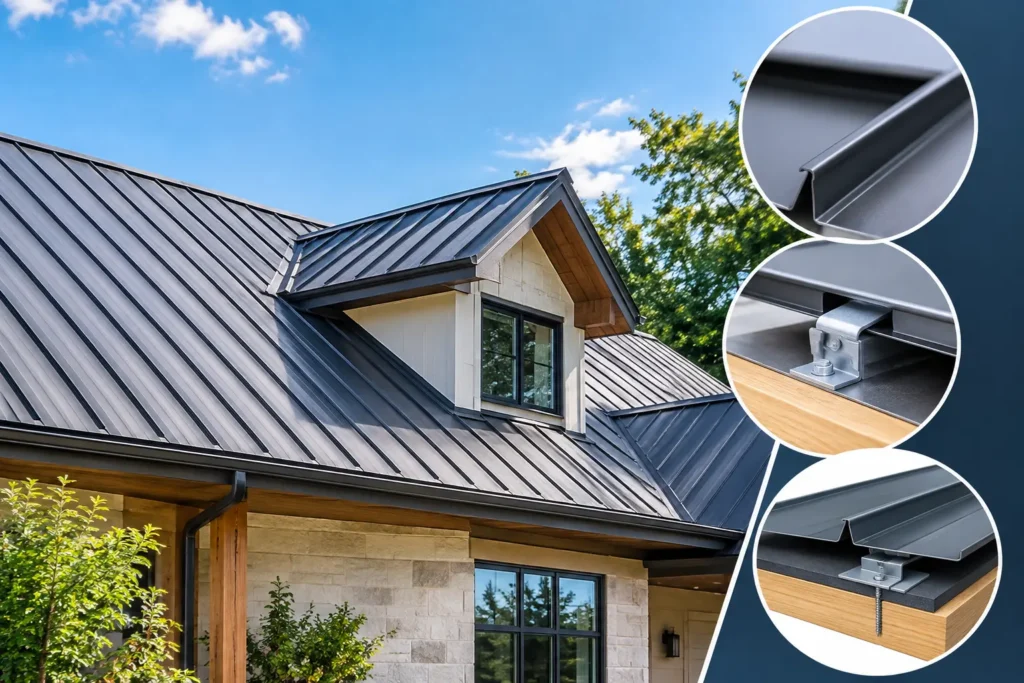
A concealed fastener metal roof is a popular roofing option for property owners who want a clean appearance, reliable weather protection, and a durable roofing system. Unlike traditional metal roofing panels that use exposed screws, concealed fastener metal roof panels hide their attachment points beneath overlapping seams or panel edges. This design reduces the number of fasteners directly exposed to rain, sunlight, and other environmental conditions.
Is Concealed Fastener Metal Roof Best Option for You? (Best Answer)
For homeowners considering a metal roof replacement, understanding how concealed fastener roofing works can make it easier to compare available materials, installation methods, and long-term maintenance requirements. The right system depends on the building’s roof slope, local weather conditions, budget, and structural requirements.
In this guide, we explain the benefits, common panel types, installation considerations, potential problems, and differences between concealed and exposed fastener metal roofing.
What Is a Concealed Fastener Metal Roof?
A concealed fastener metal roof is a roofing system in which the screws, clips, or other attachment components are hidden beneath the metal panels or within their seams. Because the fastening points are not generally visible on the finished roof surface, the system creates a smooth and consistent appearance.
Standing seam metal roofing is one of the best-known examples of concealed fastener roofing. Its panels run vertically from the eaves toward the ridge, with raised seams connecting adjacent panels. Depending on the product, the panels may attach using concealed clips or an integrated fastening flange.
These systems are available in several metals, including galvanized or coated steel and aluminum. Panel thickness, seam height, coating, attachment method, and finish vary by manufacturer.
It is important to understand that not every concealed fastener panel is a standing seam panel. Some systems use different profiles and fastening arrangements, so homeowners should evaluate the actual product specifications rather than relying on the general category name.
How Does a Concealed Fastener Metal Roofing System Work?
A concealed fastener roofing system relies on the coordinated performance of its panels, attachment components, underlayment, flashing, and roof structure.
The metal panels overlap or interlock to create a weather-shedding surface. Hidden clips or fastening flanges secure the panels to the roof deck or supporting structure. The exact arrangement depends on the selected roofing product.
Many clip-attached standing seam systems are designed to accommodate thermal movement. Metal expands as temperatures rise and contracts as temperatures fall. Properly designed clips allow the panels to move as intended while maintaining their attachment to the building.
The roof’s performance also depends on correct installation around eaves, ridges, valleys, walls, chimneys, vents, and other penetrations. Even high-quality metal panels can develop leaks when these details are improperly designed or installed.
The Metal Construction Association’s standing seam roof clips guide provides additional technical information about clip selection, attachment, and thermal movement.
Main Types of Concealed Fastener Metal Roof Panels
Different concealed fastener systems serve different building designs and installation requirements. Understanding the common options helps property owners narrow down their choices.
1. Standing Seam Metal Roof Panels
Standing seam panels feature raised vertical seams that connect adjacent metal panels. Their concealed fastening arrangements create a clean architectural appearance that works well on many residential and commercial buildings.
Some systems use snap-lock seams, while others require mechanical seaming equipment to lock the panels together. The appropriate option depends on the product specifications, roof design, and environmental conditions.
Standing seam roofing is worth considering for homeowners who prefer a modern finish and want to reduce the number of exposed fasteners across the main roof surface.
2. Snap-Lock Concealed Fastener Panels
Snap-lock panels connect through specially designed panel edges that snap together during installation. Depending on the system, they may attach through concealed clips or an integrated nail flange.
These systems can simplify installation compared with some mechanically seamed profiles. However, compatibility with the roof slope, deck, wind loads, and manufacturer’s requirements must be confirmed before selecting a panel.
3. Mechanically Seamed Metal Roofing
Mechanically seamed systems use specialized tools to fold and lock adjacent panel edges together. This creates a secure seam designed for the specific roofing assembly.
Some mechanically seamed systems are suitable for demanding commercial or architectural applications. Their performance depends on the selected profile, seam configuration, substrate, and approved installation details.
Homeowners should not assume every mechanically seamed roof is suitable for every low-slope application. Minimum slope and water-resistance requirements differ among products.
Benefits of a Concealed Fastener Metal Roof
Concealed fastener metal roofing offers several advantages, although its suitability depends on the project.
Fewer Exposed Fastening Points
Traditional exposed fastener roofing has screws visible on the exterior panel surface. Concealed fastener systems hide most of their attachment components, reducing direct exposure of those components to the weather.
This design can reduce some maintenance concerns associated with exposed fasteners and their sealing washers. However, it does not eliminate the possibility of leaks at seams, flashing, penetrations, or roof edges.
Clean and Modern Appearance
Concealed fastener panels provide a streamlined appearance without rows of visible screw heads across the main roof surface. Standing seam panels are especially popular on contemporary homes, additions, and commercial properties.
The available colors, seam profiles, and finishes also allow property owners to coordinate the roof with the building’s exterior design.
Accommodation for Thermal Movement
Many concealed clip systems are engineered to accommodate the expansion and contraction of metal panels. When the appropriate clips and fastening details are installed correctly, the roof can move as intended during temperature changes.
This consideration is particularly important in climates with significant differences between daytime and nighttime temperatures.
Potential for Long-Term Durability
Metal roofing can provide a long service life when the material, coating, attachment system, and installation quality are appropriate for the building.
Concealed fasteners may reduce exposure-related deterioration at certain fastening points, but overall durability still depends on corrosion resistance, workmanship, drainage, maintenance, and environmental conditions.
Suitable Options for Residential and Commercial Buildings
Concealed fastener metal roofing is available for many different architectural applications. Homeowners may choose it for a complete roof replacement, while commercial property owners may consider it for new construction or renovation projects.
The selected system must be compatible with the roof’s structural design, slope, and required performance characteristics.
Concealed Fastener vs. Exposed Fastener Metal Roofing
One of the most important decisions when choosing metal roofing is whether to use concealed or exposed fastener panels.
| Feature | Concealed fastener | Exposed fastener |
|---|---|---|
| Visible screws | Generally hidden | Visible on the panel surface |
| Appearance | Clean, streamlined finish | More visible fastening pattern |
| Installation | Often more specialized | Often simpler for compatible systems |
| Initial cost | Usually higher | Often more budget-friendly |
| Fastener maintenance | Fewer directly exposed fasteners to inspect | Screws and washers may require periodic attention |
| Thermal movement | Depends on system design; many use clips | Depends on panel and attachment design |
| Best application | Architectural and selected commercial projects | Many agricultural, utility, residential, and commercial applications |
Concealed fastener roofing generally costs more upfront because of the panel design, accessories, and installation requirements. Exposed fastener roofing may be a practical choice when initial budget is the main concern.
Neither option is automatically best for every building. Compare the complete roofing assemblies, including underlayment, flashing, warranties, and installation specifications.
How Much Does a Concealed Fastener Metal Roof Cost?
The cost of a concealed fastener metal roof depends on several factors, so a single price per square foot cannot accurately represent every project.
Important cost factors include:
- Metal type and panel quality: Steel and aluminum systems have different material costs, coatings, and performance characteristics.
- Panel profile: Standing seam systems and other architectural profiles may require specialized components or equipment.
- Roof size and complexity: Valleys, dormers, skylights, chimneys, and numerous penetrations increase labor and detailing requirements.
- Existing roof removal: Removing old roofing materials can add labor, disposal, and preparation expenses.
- Underlayment and flashing: The roof assembly may require specific membranes, edge details, and compatible accessories.
- Deck repairs: Damaged sheathing or structural components may need attention before installation.
- Local labor and project conditions: Contractor availability, roof accessibility, and local construction requirements affect the final estimate.
For an accurate comparison, request an itemized estimate that identifies the panel system, metal gauge, finish, underlayment, flashing, removal work, and warranty coverage.
Property owners considering a replacement can also read this guide to recognizing when a roof needs replacement.
How Is a Concealed Fastener Metal Roof Installed?
Proper installation is essential to the performance of any concealed fastener roofing system. Although procedures vary by manufacturer, several stages deserve particular attention.
1. Inspect the Roof Structure
Before installation begins, the contractor should assess the roof deck, supporting structure, existing damage, and overall suitability for the selected roofing system. Any required structural repairs should be addressed before the panels are installed.
2. Prepare the Underlayment
The roof assembly must include the underlayment and moisture-control components required by the product specifications and applicable building codes. The correct materials depend on the roof design, substrate, slope, and environmental conditions.
3. Plan Panel Layout and Attachment
Panel width, seam alignment, clip placement, and fastening details must follow the approved installation instructions. The attachment system must provide the required resistance to wind uplift while accommodating movement where the system is designed to float.
Fastener spacing should never be guessed. It depends on engineering requirements, roof zones, panel specifications, and supporting materials.
4. Install Panels and Seams
The installer positions the panels, secures the concealed attachment components, and connects the panel edges using the specified method. Mechanically seamed systems require the appropriate equipment and seam-forming procedure.
Panel alignment and seam engagement should be checked throughout the installation.
5. Complete Flashing and Roof Edges
Eaves, ridges, valleys, wall transitions, and roof penetrations need compatible flashing and trim. These areas are particularly important because water can enter when the details are poorly coordinated.
6. Inspect the Finished Roof
A final inspection should check panel alignment, seam engagement, flashing, roof edges, drainage, and compliance with the manufacturer’s instructions. Any installation concerns should be addressed before the project is considered complete.
The National Roofing Contractors Association provides information about its metal panel roof systems installer certification, which can help property owners understand the importance of installation expertise.
Common Concealed Fastener Metal Roof Problems
Although concealed fastener roofing offers several benefits, it is not maintenance-free. The following problems can occur if the system is poorly designed, incorrectly installed, damaged, or inadequately maintained.
Roof Leaks Around Flashing and Penetrations
Leaks may develop around chimneys, vents, skylights, valleys, or wall transitions. Concealed fasteners do not eliminate the need for properly installed flashing and water-management details.
If water enters the building, the source should be identified before repairs are attempted.
Restricted Thermal Movement
Metal panels expand and contract as temperatures change. If a system’s attachment details prevent the movement it was designed to accommodate, stress may develop in panels, clips, or connections.
The correct repair depends on the panel system and the cause of the problem. Altering clips or fasteners without consulting the manufacturer’s instructions can make the situation worse.
Corrosion or Incompatible Materials
Metal components can deteriorate when exposed to unsuitable environmental conditions or incompatible materials. Correct material selection, protective coatings, and compatible fasteners are important for long-term performance.
Poor Drainage
Debris, incorrect detailing, or unsuitable roof geometry can interfere with water drainage. Standing water and persistent moisture should be investigated rather than treated as normal conditions for a roof system that is not designed for them.
For additional advice on weather-related roof concerns, see this roof maintenance guide for harsh weather conditions.
Is Concealed Fastener Metal Roofing Suitable for Lubbock, Texas?
Property owners in Lubbock and the wider West Texas region should consider local weather conditions when selecting a roofing system. Strong winds, hail, intense sunlight, and temperature changes can all influence roof performance.
A concealed fastener metal roof may be worth considering, but the label alone does not guarantee superior storm protection. The panel profile, metal thickness, attachment design, edge details, supporting structure, and product testing are all important.
When comparing systems, ask the contractor about:
- Tested wind-uplift performance and applicable design requirements.
- The panel’s resistance to hail damage and the limitations of its warranty.
- Protective coatings and suitability for local environmental conditions.
- Proper attachment details around roof edges and penetrations.
- Maintenance requirements and access to replacement components.
Metal roofing can dent during hailstorms, and the degree of damage depends on the product, impact conditions, and other factors. No roofing material should be described as completely hail-proof without appropriate evidence.
For more practical weather-preparation advice, explore this guide to preparing a roof for extreme weather.
How to Maintain a Concealed Fastener Metal Roof
Routine inspections help identify developing problems before they cause extensive damage. The appropriate inspection schedule depends on the roof’s age, exposure, manufacturer’s recommendations, and any severe weather events.
Property owners should arrange inspections when there are signs of leaks, storm damage, loose trim, damaged flashing, or unusual panel movement. Gutters and drainage paths should also be kept clear where accessible and safe to maintain.
Avoid walking on metal roof panels unless the manufacturer’s instructions and appropriate safety procedures permit it. Incorrect foot placement can damage certain profiles, and roof work presents a serious fall risk.
Repairs should use compatible materials and follow the roofing system’s specifications. Applying generic sealant to every visible seam is not a reliable substitute for diagnosing the actual source of a leak.
For additional background, read this DIY roof maintenance guide for homeowners.
Frequently Asked Questions
It depends on your priorities. Concealed fastener systems offer a cleaner appearance and reduce direct exposure of most attachment points. Exposed fastener systems are often less expensive initially and may be suitable for simpler applications. Compare the complete systems and their maintenance requirements before deciding.
Service life varies with the metal, coating, installation quality, climate, maintenance, and other conditions. A well-designed metal roof can provide decades of service, but there is no universal lifespan that applies to every concealed fastener system. Check the manufacturer’s product documentation and warranty.
No roofing system is completely immune to leaks. Concealed fasteners reduce the number of attachment points exposed on the panel surface, but leaks can still occur at flashing, seams, roof edges, penetrations, or damaged areas.
Some metal roofing systems may permit installation over existing shingles, while others require removal. The decision depends on the selected product, roof condition, deck, local building codes, and manufacturer’s instructions. The existing roof should be inspected before choosing an installation method.
Not exactly. Standing seam roofing is a common type of concealed fastener metal roofing, but concealed fastener systems also include other panel profiles and attachment methods.
It can be worthwhile for property owners who value its appearance, concealed attachment design, and potential long-term performance. However, the additional upfront expense may not be justified for every building. Compare installation estimates, warranties, expected maintenance, and the requirements of your property.
Conclusion
A concealed fastener metal roof can be an excellent option for homeowners and commercial property owners seeking a clean appearance and a durable roofing assembly. Its benefits include hidden attachment points, architectural versatility, and the ability of many systems to accommodate thermal movement when correctly designed.
However, the results depend on choosing the right panel profile, compatible materials, appropriate attachment details, and qualified installation. Roof slope, drainage, flashing, weather exposure, and maintenance requirements should all be evaluated before making a decision.
For property owners planning a metal roof installation or replacement, comparing complete roofing systems is more useful than focusing on panel appearance alone. A professional assessment can help determine whether concealed fastener roofing is appropriate for the building, climate, and budget.